 News, stories and perspectives that matter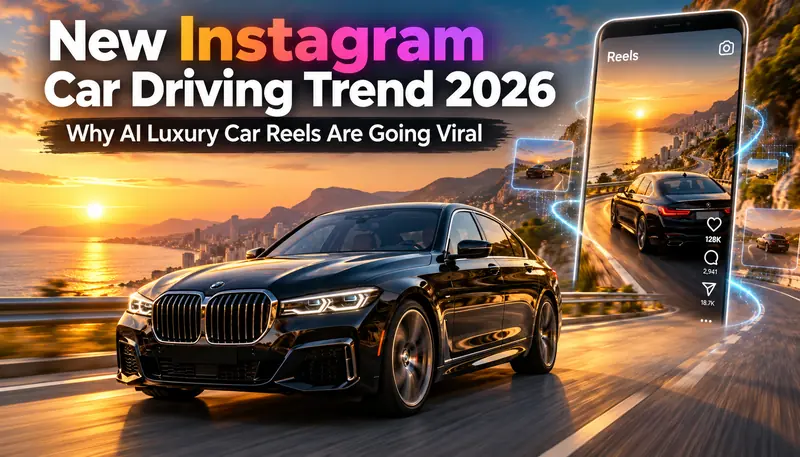
New Instagram Car Driving Trend 2026: Why AI Luxury Car Reels Are Going Viral
Instagram has a new viral obsession in September 2026 — AI-generated car-driving Reels. Instead of actually arranging an expensive luxury car, professional camera crew and cinematic road shoot, creators are now using artificial intelligence to make themselves appear to be driving premium cars in highly realistic videos.
The trend has become especially noticeable with videos featuring black Mercedes-style luxury cars, cinematic windshield shots, smooth camera movement and creators smiling, posing or making subtle hand gestures while appearing to drive. Several tutorials covering the trend were published between September 21 and September 24, 2026, reflecting how quickly the format has spread across Instagram Reels and other short-video platforms.
What Is the Viral Instagram Car Driving Trend?
The basic concept is surprisingly simple.
A creator provides a photograph of themselves and uses an AI video-generation platform to transform that image into a short cinematic sequence. The finished Reel can make it appear as though the person is sitting behind the steering wheel of a moving luxury car.
One popular version begins with an exterior view of a black luxury car. The virtual camera then moves toward the windshield, revealing the creator sitting inside and driving. Some versions include a smile, wave, hand gesture or subtle head movement to make the clip feel more natural.
Other versions show the car travelling along highways, mountain roads or sunset routes.
Recent guides specifically describe creators using Google Flow and reference images or videos to generate these driving sequences.
Viral Instagram Car Driving AI Video Prompt 2026
Create a highly realistic cinematic vertical video using the uploaded person’s photo as the main character. Keep the person’s face, hairstyle, skin tone, body proportions, and identity unchanged.
Scene: A premium black luxury sedan is driving smoothly on a clean open highway during golden hour. Start with a cinematic exterior front-side shot of the moving car. The camera should smoothly track alongside the car, then gradually move toward the windshield and reveal the person sitting naturally in the driver’s seat.
The person should look confident and relaxed, wearing stylish modern clothes, keeping both hands naturally near the steering wheel. Add subtle realistic movements such as blinking, a slight smile, gentle head movement, natural hand movement, and realistic body motion caused by the moving car.
The road and background must move naturally to create a convincing driving effect. Add realistic windshield reflections, sunlight reflections on the car body, subtle motion blur on the road and wheels, realistic shadows, premium car interior details, dashboard lighting, and natural depth of field.
Camera movement should be smooth, stable, luxurious, and cinematic — like a professional automotive commercial. Avoid shaky camera movement.
Important:
Do not change the person’s face.
Do not distort hands or fingers.
Keep the steering wheel and dashboard realistic.
Do not create extra limbs or duplicate objects.
Keep the person seated correctly inside the car.
Maintain realistic car proportions and movement.
No text, logos, watermarks, or subtitles.
Photorealistic, not cartoon or CGI-looking.
Premium commercial lighting.
Ultra-realistic facial details.
Vertical Instagram Reel format, 9:16.
Duration: approximately 6–8 seconds.
Smooth cinematic motion throughout.
Why Is the Trend Going Viral?
One reason is obvious: it creates the appearance of an expensive automotive shoot without requiring the creator to actually organize one.
Traditionally, producing a cinematic luxury-car Reel could require a suitable vehicle, driver, camera equipment, videographer, location and considerable editing.
AI dramatically reduces those barriers.
A normal photograph can become the starting point for something resembling a polished automotive commercial. Recent examples of the trend emphasize cinematic camera movement, windshield views, road motion, reflections and natural-looking movements inside the vehicle.
There is another important factor: fantasy.
Luxury cars have always performed well in aspirational social-media content. AI now allows almost anyone to place themselves inside that visual world, even when the scene was never physically filmed.
The Black Mercedes Look Is Everywhere
A particularly recognizable version of the trend features a black Mercedes-Benz or Mercedes-style luxury sedan.
Typically, the car is shown approaching the camera or driving along an open road before the viewpoint moves toward the windshield. The creator then appears behind the steering wheel.
Some variations use daylight, while others rely on golden-hour sunsets, highways or dramatic landscapes to give the video a premium feel.
Multiple trend guides published this week have focused specifically on the Mercedes version of the format.
How Are People Creating These Videos?
The workflow varies depending on the AI tool being used, but a typical process looks like this:
1. Choose a clear photograph
Creators generally start with a sharp portrait where the face is clearly visible. Good lighting can help AI tools maintain facial consistency.
2. Choose or describe the car scene
The creator specifies the car, road, lighting, clothing, driving position and camera movement they want.
3. Use an AI video generator
Google Flow is one of the tools frequently mentioned in recent tutorials about this particular trend. Some workflows use a reference driving video along with the creator's photograph.
4. Generate the driving sequence
The AI attempts to recreate the road movement, vehicle interior, reflections and character movement while keeping the person's appearance recognizable.
5. Add music and final editing
Creators then usually convert the clip into a vertical Reel, add audio, transitions, captions or additional effects and upload it to Instagram.
Why Camera Movement Matters So Much
The strongest part of this trend isn't simply placing somebody inside a car.
It's the cinematic movement.
The virtual camera may begin outside the vehicle, move toward the windshield and transition into a close view of the driver. That movement helps create the illusion that the scene was captured using professional automotive camera equipment.
Some creators also add realistic details such as:
Natural steering-wheel movement
Moving road reflections
Windshield reflections
Head and hand movement
Changing background scenery
Sunset lighting
Motion blur
Headlight effects
Slow camera zooms
These small details can make a huge difference between an obvious AI clip and a convincing cinematic Reel.
AI Is Changing Instagram Trends
The car-driving format is part of a much larger shift happening across short-form social media.
Creators are increasingly using generative AI not just to edit existing footage but to create scenes that were never physically recorded.
The trend also shows how quickly AI-generated formats can move across Instagram Reels, YouTube Shorts and Facebook Reels.
However, broader Instagram trend analysis in September 2026 suggests there isn't just one universal winning format. Short reaction videos, longer entertainment clips, tutorials, transformations and cinematic content are all competing for attention.
That means using an AI trend alone doesn't guarantee views. The idea, opening seconds, personality, audio and overall execution still matter.
Can Anyone Create the Trend?
For most creators, yes.
You don't necessarily need professional video-editing experience. The main ingredients are generally:
A good photograph
An AI video-generation tool
A suitable prompt or reference video
A vertical 9:16 format
Music or audio suitable for Instagram Reels
A little experimentation
AI video generation isn't perfect, though. Hands, steering wheels, reflections and facial features can sometimes become distorted.
Generating several versions and selecting the most natural-looking clip may produce better results.
Don't Forget That It's AI
As AI videos become increasingly realistic, viewers may not always immediately recognize that what they are watching was generated.
Creators should therefore be careful about presenting fictional AI-generated scenes as genuine real-world footage, especially when the content could mislead viewers.
For entertainment-oriented car Reels, being transparent that a video is AI-generated can help audiences understand what they are seeing.
What's Next?
The current car-driving Reel trend demonstrates just how rapidly AI is changing social-media content creation.
Today it's a creator driving a luxury Mercedes.
Tomorrow it could be exotic supercars, futuristic vehicles, cinematic motorcycles or completely imaginary vehicles generated from a single photograph.
The biggest change is that creators no longer need to ask only:
Leave a Review
Share your thoughts about this article. Reviews appear after moderation.